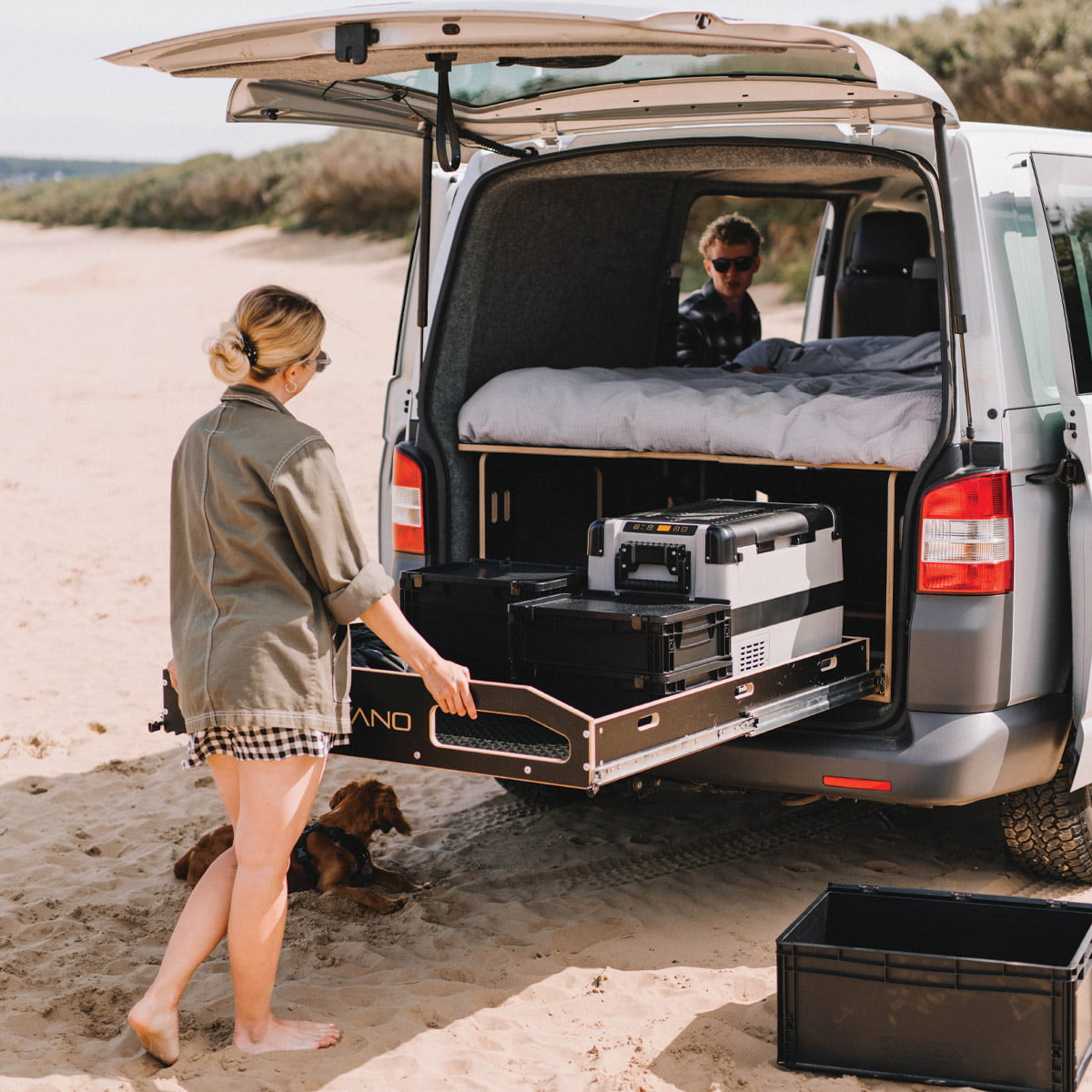


Most people who want a campervan don't need one. They need a van that does the school run or the week's work, carries the bikes, boards or the dog at the weekend, and lets them sleep in it a few nights a year. That's a day van, and a kombi is the best place to start one.
Why we started building these
A kombi is the do-everything van. It carries passengers like a car, the rear seats fold flat so you can carry long loads over the top, and that same space is big enough to sleep in. It's the best of both worlds between a car and a van.
But leave that space empty and whatever you put in it slides around. And because a kombi has glass side and rear windows as standard, anything you carry, tools especially, is on show to anyone walking past.
So when I designed the first Switch, around my own 2011 2.5 TDI Transporter, the brief was simple. Keep all of the kombi's factory versatility. Then add what it was missing: a bed you can actually sleep on, a bulkhead between passengers and the load, organised storage you can reach without climbing in, and a stealth shelf that keeps tools out of sight. I wanted one van that worked for me as a tradesman in the week and still got me away at the weekend, like a multi-tool. It's been through a lot of iterations since, but that's still the idea: take an extremely versatile vehicle and make it more versatile.
What is a day van?
A day van sits between a plain van and a full campervan. It has seats for passengers, space for kit and somewhere to sleep, but usually no kitchen, no sink and no fixed furniture taking over the load bay. Ask five converters for a definition and you'll get five answers, but the idea is the same: a van you use every day that can also take you away.
You'll also hear it called a kombi camper (or combi camper): a kombi you drive every day with the seats in, that you can also camp in. That's exactly what a kombi with one of our beds is.
Because there's less built in, a day van costs less than a full conversion, keeps more of its load space, and is easier to live with as your only vehicle.
What counts as a kombi conversion?
A kombi is a van with a second row of seats behind the cab and an open load area behind that.
"Kombi conversion" gets used for two different things. Some converters use it to mean turning a panel van into a kombi, by fitting windows and a second row of seats, often for tax and VAT reasons (we've covered that side in kombi vans and business tax). In this post we mean the other sense: adding a bed and storage to a van that's already a kombi.
Used that way, a kombi conversion works around the existing kombi seats rather than replacing them. That's the important bit: the seats are the reason you bought a kombi, so a good kombi conversion keeps them.
That rules some popular options out. A rock and roll bed, for example, means taking the kombi seats out and bolting in a seat that slides into a bed. It's a well-proven setup, but it's a campervan conversion rather than a kombi conversion: you've replaced the very thing that made the van a kombi.
What's left are the options that keep the seats:
- Bed platform. A flat board that sits over the folded seats. Cheap and quick, but it's just a bed: nothing underneath, nowhere for kit while you sleep, and the load still slides around the rest of the week.
- Kombi bed system. A unit that sits behind the seats as a bulkhead and storage, then becomes a bed over them. This is what we make. The van stays a van, and the conversion comes out when you sell it.
If you want a kitchen and a pop-top and plan to tour for weeks at a time, a full campervan conversion is the right answer, and it's permanent. If the van still has to work for a living, it usually isn't.
How the Switch works around the seats
With the seats up, the Switch is a bulkhead between passengers and the load, with a full-extension drawer underneath rated to 180kg that slides out past the bumper, and a shelf on top that keeps what's in the drawer out of sight. Fold the seats, flip the platform, and the whole rear of the van is a flat bed: 1,900 × 1,475mm in a short wheelbase and 2,300 × 1,475mm in a long wheelbase. Changing between bed and bulkhead takes seconds, and the drawer works in every position. Nothing is cut, drilled or permanently changed. See our kombi bed systems.
Who it works for
Trades by week, away at the weekend
This is where it started. The drawer holds the tools all week, the bulkhead keeps them away from passengers, the shelf keeps them out of sight through the kombi's windows, and on Friday the same van becomes somewhere to sleep.
Riders and surfers
Bikes go on a bike bar above the drawer, wet kit goes in the drawer, and you sleep at the trailhead or the beach car park and are first out in the morning. A rubber platform mat takes the mud and salt.
Families and dogs
A kombi day van is a second car with a bed in it. Seats for the kids in the week, the dog's bed on the platform, and the odd night away without booking a cabin. The mattress folds away behind the seats when it isn't needed.
A note for Transit Custom owners
The 2023+ Ford Transit Custom doesn't come as a kombi in the VW sense. Confusingly, Ford does sell a "Transit Custom Kombi", but it's a multi-row passenger layout much closer to a Tourneo, and our beds don't fit it. The Double Cab-in-Van doesn't work either: it has a fixed bulkhead behind the rear seats, so they don't fold flat. What a lot of owners do is fit a second row of Tourneo seats to a panel van, which gives the same layout as a VW Kombi, and the Switch works with that exactly as it does in a Transporter. A second row only, not a third.
What to check before you buy a day van bed
- Does it keep your seats? If it replaces the kombi seats, it isn't a kombi conversion.
- Bed length. If you're over six foot, check the short wheelbase length before you commit, or go long wheelbase.
- What's left when it's not a bed. A bed that eats the load bay all week isn't a day van, it's a small camper.
- Security. Kombis have windows all round. If you carry tools or expensive kit, you want it hidden, not just stored.
- Removability. If the van is leased, financed or likely to be sold in a few years, a system that comes out with nothing left behind protects its value.
- Your insurer. Tell them about anything you add. A removable bed and storage unit is usually a simpler conversation than a full conversion.
- Tax. If the van goes through the business, how it's set up matters. We wrote a plain-English take on kombi vans and business tax.
Which Ovano system for your van
- VW Transporter T5, T5.1, T6 and T6.1: the Switch XL for the widest drawer, or the Switch Narrow if you carry boards, ladders or anything long.
- New VW Transporter T7: the Switch for T7, which folds flat over the factory kombi seats.
- 2023+ Ford Transit Custom: the Switch for Transit Custom in a panel van, with or without a second row of Tourneo seats. For a Double Cab-in-Van, the Crew Cab Storage System.
- Kia PV5: coming before Christmas 2026. Register your interest.
Not sure what you've got? Send us a photo of the back of your van and we'll tell you what fits.