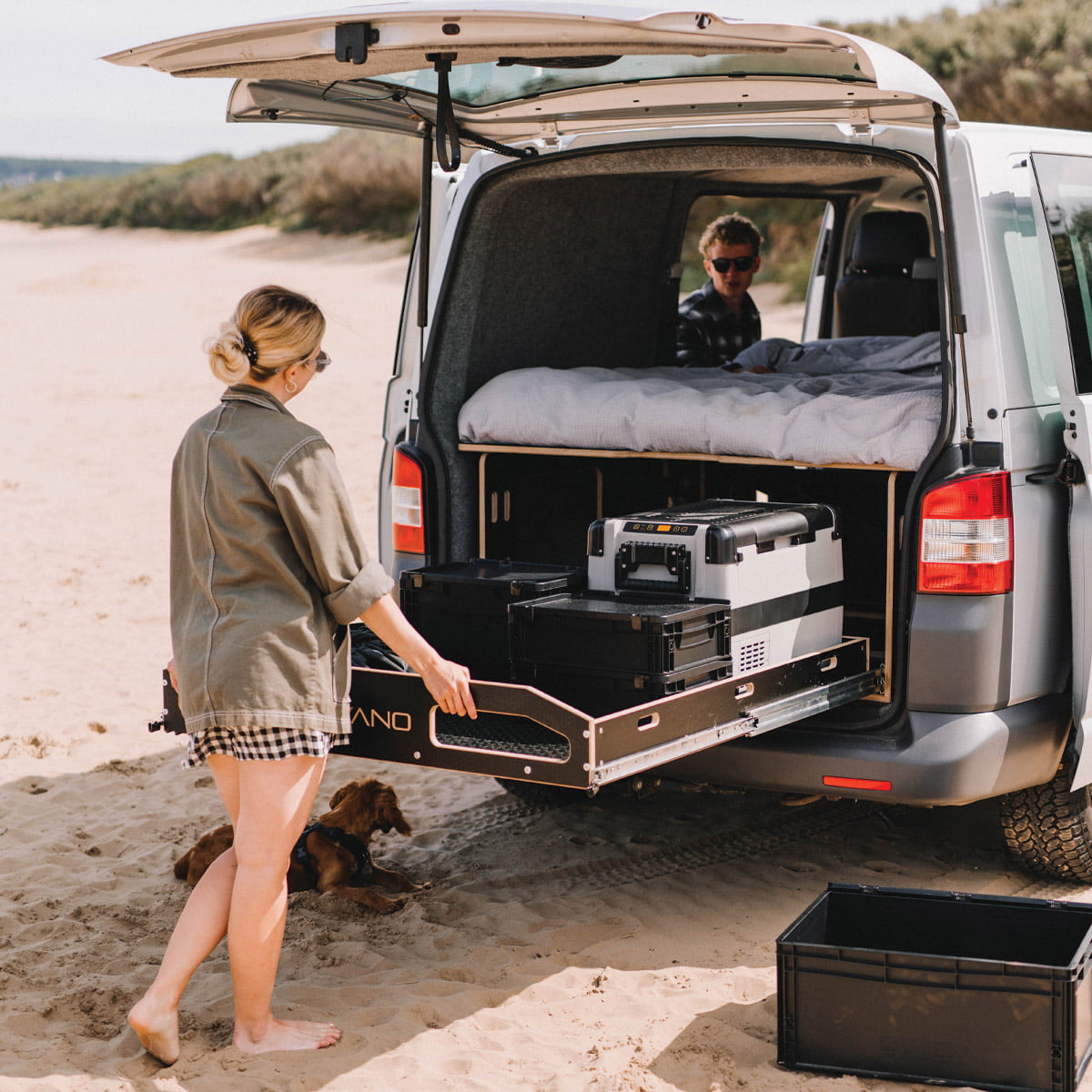


We’ve had more conversations about the new Transporter than any other van in a long time.
Most of them start the same way: "It’s a Ford". "It’s got a wet belt". "It doesn’t look like the T6" And a lot of people are worried it won’t be what previous generations were.
So rather than repeating what forums or YouTube comments are saying, this is just our view, based on having one in front of us, fitting systems to them, and speaking to people who are genuinely considering buying one.
Why people are nervous about it
The concerns tend to fall into three buckets:
- It’s now tied to Ford
- The introduction of a wet belt
-
The look and feel being different to older Transporters
None of those are stupid concerns, especially if you’ve owned a T5, T6, or T6.1 and seen how well they’ve held their value. Where it gets messy is when all of those things get lumped together as “this van is a bad idea”, without much nuance.
The wet belt conversation (with a bit of context)
This is the big one.
If you’re buying new, and you’ve got:
- A solid manufacturer warranty
- A proper service plan
-
And you’re the first owner
Then the wet belt, while not ideal, isn’t the ticking time bomb it’s often made out to be in the early years. Volkswagen are clearly confident enough to stand behind the platform with a 5 year Warranty, and for a lot of business buyers, that’s what matters most.
Where it becomes more of an unknown is second-hand.
Once these start filtering into the used market, service history becomes absolutely critical. Without a perfect record, wet belts will put buyers off, and that will affect residual values. It’s hard to see these holding value in the same way older Transporters did. Realistically, depreciation is likely to look more like a Transit than a T6.1.
Also worth noting that on the PHEV & E-Transporter versions, there is no wet belt.
“It’s not really a Transporter anymore”
We hear this a lot, and emotionally, it’s understandable.
But there are also areas where the new van is genuinely better, and those tend to get drowned out:
- The infotainment and interior tech are a step on
- The driving experience feels more refined
- The load space is wider
-
Kombi's now come with three individual rear seats instead of a bench
That last one is a bigger deal than it sounds. Three single seats make the van far more versatile for people mixing work, passengers, and leisure use.
There’s also the quality side of things. Despite the Ford collaboration, these vans still go through Volkswagen quality procedures. They should be built to a higher standard than an equivalent Transit, even if they feel different to older Transporters.
On looks, it’s worth remembering: every generation gets criticised when it launches. The T6.1 did. Now people love it. Once the aftermarket companies get hold of these, Van Haven, Leighton Vans, TransporterHQ, they will look better. They always do.
Things you won’t see mentioned in reviews
Trim and finish is where some of the early vans feel a bit unfinished.
We’ve already seen things like:
- B-pillar trims that just stop once bulkheads are removed
- Exposed seat frames on panel-van-based builds
- Ceiling panels that don’t seem to have a proper ending
-
Kombi's that don’t clearly feel like crew cabs or kombi's
In at least one case, it genuinely wasn’t clear whether the van had left the factory incomplete or whether that was just how it was meant to be.
None of this is unfixable. Aftermarket companies will absolutely fill these gaps. But buyers should be aware that some vans don’t feel as “finished” out of the box as older Transporters did. And maybe this will change when they’ve produced a few more.
Update- Vanworx has got the contract for making good of unfinished trims, as well as for the Sportline builds and so all Kombi's now go via them for finishing. This is the main reason for the massive delays of the first lot of kombi's.

What changes when fitting Ovano systems
From an Ovano point of view, the new Transporter is a bit more involved — not because it’s poorly designed, but because it’s no longer as uniform as older generations.
On previous Transporters, fitting was close to one-size-fits-all. The factory fixing points were consistent, which made installs very predictable.
On the new vans, panel vans, kombi's, and crew cabs all differ slightly in where and how those fixing points are laid out. Because Ovano systems use the vehicle’s standard fixing points rather than adding permanent ones, those differences matter more.
In practice, that means:
- The fitting approach changes slightly depending on the base vehicle
- If you start with a panel van but plan to convert it later, it’s worth thinking ahead about which system you choose
- Installs take a bit longer than on older Transporters — not by much, but it’s noticeable
-
On kombi's and crew cabs, things like swing-out tables involve a few extra steps
Everything is still DIY-friendly, and all parts and brackets are retrofittable if the van changes later. It just adds a layer of planning that didn’t really exist before.
For anyone not confident fitting themselves, it’s also one of the areas where having us do the install makes more sense than it used to.
Small things people don’t expect
A few complaints keep coming up:
- The speed limit warning beep annoys people quickly
- Some engines don’t feel especially quick
- Paint quality has been inconsistent
-
Dealers don’t always seem clear on how kombi's should arrive
Interestingly, the PHEV versions have surprised people in a good way. Performance and fuel efficiency wise, feedback on those has been very positive.
Update - at time of writing, you can lease an E-transporter kombi for £169 per month with a £2k deposit. From a business perspective that could be incredibly cheap motoring AND you can hand it back after 2 years without the crazy depreciation you'd get from buying one. If its being used for local work this may be a really feasible option. The feedback so far is that the claimed mileage on the battery is approx 200, but more realistically 150.
Who this van probably isn’t for
If you’re:
- Expecting the same residual values as older Transporters
- Treating the van as a long-term investment
- Building a passion project you plan to keep forever
-
Or you prefer a more mechanical, analogue driving feel
Then this probably isn’t the right platform for you right now.
That doesn’t mean it never will be, just that it’s not the same proposition as previous generations.
The simplest way to decide
This usually answers the question very quickly:
If your a business owner, and plan on changing vans every few years?
It makes sense.
If your looking for a Van-for-life or long-term passion built.
Probably not. Yet.
What we’d actually say to a friend
Honestly? We’d say go for it, but be disciplined with servicing.
If you’re choosing between a Transit and a Transporter now, the real differences come down to:
- Styling (completely subjective but I actually like it)
- Price at the time
-
Warranty and service packages available
Ford fleet discounts are strong at the moment. Volkswagen aren’t matching this yet, but they could be forced to change. That can make a real difference as resellers who are buying hundreds of vans should be able to pass fleet discounts on.
On looks, plenty of people prefer the Transit’s more aggressive front end. We don’t, it feels a bit “in your face”. The Transporter is still more understated, and that suits a lot of buyers.
The biggest misconception we keep seeing
A lot of people online are convinced these vans won’t catch on.
That doesn’t line up with what’s actually happening.
Companies that have committed to them are selling a lot of units. New Transits are already selling for less than second-hand T6.1s. Aftermarket companies are investing heavily in making them look and work better.
Whether people like it or not, this platform is almost certainly going to become the dominant one, whether thats the Transporter or the Transit is still yet to be seen.
Final thought
The new Transporter isn’t the old Transporter but that doesn’t automatically make it worse. It just makes it different, and whether it’s right or wrong depends far more on how you plan to use it than on who built it.
If you understand that going in, you’re much less likely to be disappointed later.
If you’re looking at one of these vans and want to talk it through, whether that’s the vehicle itself or how one of our systems fits into it, please do get in touch. We’re always happy to talk things through before you commit.