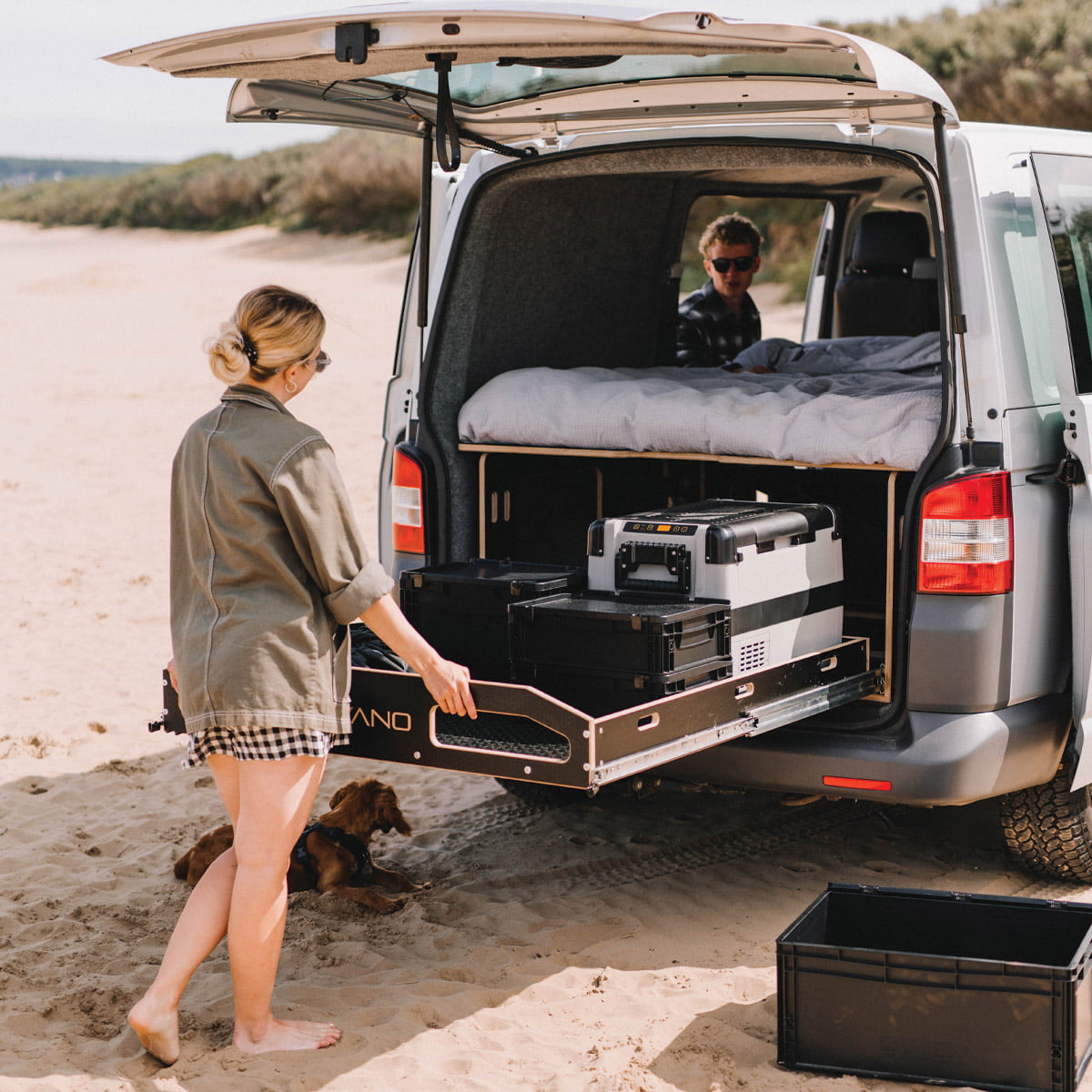


If you’ve seen our new OneTouch drawer system and thought
“That looks nice, but do I really need it?”
you’re not alone.
So before getting into why we built it or how it works, it’s worth starting with the basics.
What actually is OneTouch?
OneTouch is a single-handed drawer release system that’s now available across our entire range of drawer products, for both Volkswagen Transporters and Ford Transit Customs.
Until now, all of our drawers — whether in Switch, Switch XL, or other configurations — have used a twin-latch system. To open them, you bend down and lift both drawer runner triggers by hand. It’s solid, reliable, and a huge improvement over having no drawer at all, which is why we’ve used that approach for the last six years.
OneTouch doesn’t replace the drawer or change how it’s mounted. It changes how you interact with it.
You release the drawer with one hand, while the other stays free to load or unload whatever you’re carrying.
No learning curve. No new behaviour to think about.
The frustration that led to it
The existing system works well, but over time two things became increasingly obvious.
The first was reach. For shorter people, or anyone with a shorter arm span, bending down and lifting both latches can be awkward.
The second and more important issue shows up when you’re actually using the van properly.
If you’re opening the drawer regularly for work, you’re often approaching it carrying tools, materials, or equipment. With the old setup, that meant putting everything down, opening the drawer, then picking it all back up again.
It doesn’t sound dramatic, but when you’re doing that repeatedly throughout the day, it becomes tiring and inefficient.
Watching customers use the drawers, and using them ourselves in real situations, made it clear that while the system was good, it wasn’t as ergonomic as it could be.
That’s when it moved from “this would be nice” to “this is worth doing properly”.
Why we didn’t rush it
From the outset, there were some non-negotiables.
It had to work genuinely one-handed.
It couldn’t reduce strength or durability.
It had to look clean and minimal, not like an add-on.
It had to be retrofittable across our products.
And above all, it had to survive real van use — not just feel good in a demo.
Because of that, development took time.
The R&D process ran for close to two years, with hundreds of revisions. Different mechanisms, materials, and layouts were tested until we were confident we’d arrived at something that improved usability without introducing new compromises.

How it works (without getting overly technical)
At a high level, OneTouch introduces a mechanical linkage that allows both drawer runner latches to be released together with a single action.
To do that without weakening the system, we’ve used a combination of custom-fabricated components made from anodised aluminium and phenolic birch ply, along with industrial-grade stainless steel bearings to ensure a smooth, positive movement.
The original runner latches are still there and still accessible. OneTouch works with them rather than replacing them.
We’ve also designed in fail-safes. If there were ever an issue with the OneTouch mechanism itself, the drawer can still be operated manually using the original latches. There’s no single point of failure.
“Isn’t this a delicate mechanism?”
This is probably the most common assumption, and it’s a reasonable one to question.
The short answer is no.
The longer answer is that we’ve approached this like a piece of machinery, not a lifestyle feature.
The system uses steel braided cable to operate the latches — the same type of cable used in bike braking systems, which are designed to cope with thousands of cycles. Even if slight stretching occurs over time, the system is fully adjustable and can be re-tensioned in seconds.
Structural components are made from 5mm anodised aluminium, chosen for strength as much as appearance, and all moving parts run on stainless steel bearings.
There’s been input from people with backgrounds in high-end mechanical engineering, including aerospace engineers. We haven’t cut corners, and we’re confident enough in the design to back it with our standard two-year warranty.
Who actually benefits most
The biggest gains are for people who use their drawers frequently.
Tradespeople and anyone working out of their van tend to notice the difference immediately. Opening and closing the drawer multiple times a day becomes quicker, easier, and less physically demanding. Several people have commented that they didn’t realise how much bending and stretching they were doing until they stopped having to do it, particularly on lowered vans.
On narrower units, the benefit is still there, but slightly less pronounced simply because the latches are closer together anyway. It’s still a nicer experience, just not as transformative as it is on wider setups like Switch XL.
If you’re mainly using the van as a weekend or day van, you’ll probably notice the benefit less often. It’s not irrelevant, but it won’t change your day in the same way it does for someone loading tools all day.
The “it doesn’t sound like much” problem
This is one of those features that doesn’t fully land until you try it.
So far, everyone who’s moved from the previous system to OneTouch has noticed the difference straight away. There’s no learning curve. As soon as you open the drawer once or twice, it just makes sense.
A lot of people have described it as something they didn’t realise they needed — until they used it.
Is this actually unique?
At the time of writing, we’re not aware of any other van conversion or drawer system offering a comparable single-handed drawer release that maintains full load strength, durability, and failsafe operation.
That’s not something we shout about lightly, but it is worth stating clearly. This is another case of us solving a problem we see every day, rather than following what already exists.
Availability and retrofitting
OneTouch is now available across the full Ovano drawer range for Volkswagen Transporters and Ford Transit Customs, including Switch and Switch XL configurations.
For existing customers, a retrofit kit is also coming soon for those who want to upgrade their current setup rather than replace it.
The quick way to decide
The simplest rule we’ve found is this:
If you’re opening the drawer more than two or three times a day, and you’re often doing it with your hands full, you’ll benefit from OneTouch.
If neither of those things apply, it’s still nice to have — just not essential.
What we’d actually say to a friend
If you’re buying a new unit, we’d say yes it’s worth having.
If you’re buying second-hand, don’t let the lack of OneTouch put you off. Having one of our drawers at all is still a night-and-day improvement over having no drawer.
OneTouch improves something that was already good. It doesn’t suddenly make the older system inadequate.
Final thought
This wasn’t about adding a feature for the sake of it.
It came from watching how people actually use their vans, noticing where small frustrations repeat themselves, and deciding to fix that problem properly rather than quickly.
If you use your drawer regularly, OneTouch makes that interaction feel more natural and less effortful. If you don’t, it stays quietly out of the way.
That’s exactly how it should be.
If you've got any questions about the Onetouch system or any of our products, please do get in touch.