

This question comes up constantly, and usually at the same point in the buying journey.
People know they’d like the extra space of a Long Wheelbase van, but they’re worried about the size. Or they feel more comfortable with a Short Wheelbase day to day, but they don’t want to end up wishing they’d gone bigger once everything’s in the back.
On paper the difference doesn’t sound huge. In reality, depending on how you use the van, it can change things quite a lot.
The bit of advice that’s technically true, but not very helpful
You’ll hear it said all the time:
“It’s only about 400mm longer.”
That’s correct, but it doesn’t really help you decide.
That extra 400mm doesn’t matter much when you’re reading spec sheets. It starts to matter once you’re actually living with the van, loading bikes, chucking kit in the back, dealing with prams, bags, tools, or trying to make everything work without constantly moving things around. Also whilst trying to fit on your drive and still be able to open the tailgate.
And if you’re coming from a small car, the step up to any van already feels big. At that point, another 400mm can feel like a lot, even if you later realise it’s manageable.
Where the difference shows up in real life
Parking and day-to-day driving
This is the main compromise with a LWB. Parallel parking is harder, and in tighter spaces you’re more conscious of the extra length. In our view, parking sensors and a reversing camera aren’t optional on a LWB, but a must.
That said, most people adapt to it faster than they expect. What feels awkward in the first couple of weeks usually becomes second nature fairly quickly.
Passenger space (often misunderstood)
In a Kombi, there’s no difference at all for passengers between SWB and LWB.
The cab is the same.
The second row is the same.
Where the difference starts is behind those seats, not where people sit. So if your concern is carrying kids or passengers comfortably, wheelbase choice doesn’t change that.
Load space: bigger doesn’t mean endless
The extra load space in a LWB does make a difference, but it’s worth being realistic about how quickly that space gets used.
If you’re moving from a car, the back of any van feels enormous at first. But once you start adding real-world items like prams, bags, bikes, tools, camping gear, that space fills up far quicker than people expect.
This is where LWB starts to earn its keep, especially if you regularly carry bulky items. It gives you more breathing room, but it’s not a magic solution. Even a LWB can feel full surprisingly quickly if everything is loose and unorganised.
Bikes are usually the deciding factor
From our point of view, mountain bikes are where the choice becomes much clearer.
In a LWB Kombi, bikes can be loaded behind the second row far more naturally. You’re not immediately fighting angles, and carrying more than one bike is realistic without folding seats. Even in this scenario the front wheel will need to be removed, unless storing the bikes on a diagonal.
In a SWB Kombi, even with the front wheel removed, bikes don’t go straight in behind the seats. They have to sit at an angle. One is usually fine. Two becomes awkward. More than that can be very difficult if not impossible without dropping seats.
This is the detail that catches people out most often, and it’s usually realised after the van’s already been bought.
The regret pattern we see
Interestingly, regret tends to run one way.
People who are worried about buying a LWB usually get used to the extra length fairly quickly and stop thinking about it day to day.
People who buy a SWB because of size concerns often still want more space later, especially if bikes or bulky gear are part of their regular use.
This comes up most with Kombis, where people are trying to make the van do a lot at once: carrying kids, carrying bikes, going away at weekends, and still being usable during the week. That’s a hard balance to strike in a SWB.
How this affects Ovano systems specifically
From an Ovano point of view, both wheelbases work but they behave differently.
In a Kombi:
-
Passenger space is unchanged
-
On a LWB, the bed platform is deliberately oversized in length to protect folded seats and to support longer loads (up to around 2300mm)
-
That extra length is useful for carrying materials or longer items
It’s worth being clear here: this doesn’t mean mattresses don’t fit. It just means the platform itself is longer than most standard mattresses, so you’re not constrained by bed length in the way you are in a SWB.
Storage changes too:
-
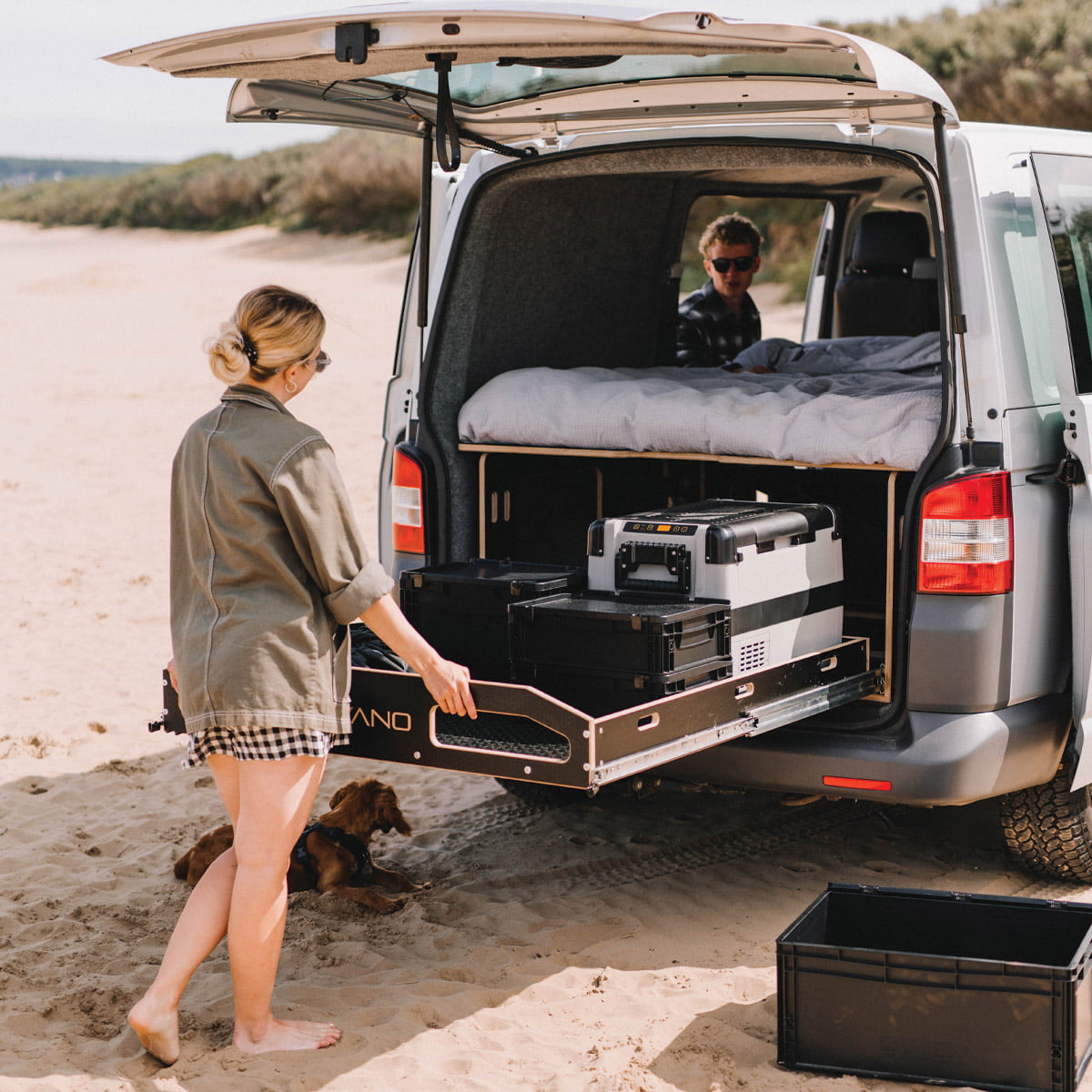
Drawer length increases from roughly 1200mm on a SWB to around 1500mm on a LWB
That extra length makes a noticeable difference to what you can carry.
The SWB, on the other hand, tends to feel more proportionate and refined. Bed sizes line up neatly with standard mattresses, and for many people it simply feels like the “right” size van just with less overall capacity.
There’s also an option people often overlook.
If you have a LWB panel van, fitting a SWB Ovano unit can work very well. It leaves a larger open space between the front seats and the system, which can be ideal for loading bikes through the side door without needing fork mounts or bike bars. If we were running a LWB panel van ourselves, that’s likely the setup we’d choose.
Space only works if it’s controlled
One thing that’s worth saying, especially with LWB vans, is that space on its own isn’t that useful.
Without some kind of constraint or organisation system, the extra room becomes hard to manage. Things slide around, stack badly, and you often end up wasting space simply because there’s nothing keeping items where you want them.
This is actually where people get frustrated. On paper the space sounds great, but in practice it can feel chaotic unless it’s structured properly. The bigger the van, the more noticeable this becomes. This really is where one of our storage systems become game changers for storage and access.
Who should choose which
If you strip it back:
-
SWB makes sense if
You’re using the van every day for commuting, school runs, and the odd weekend away, and you don’t regularly carry bulky gear. -
LWB makes sense if
You have a clear use case — MT BIKES, tools, equipment or you regularly need to carry people and load space at the same time.
The quick way to decide
This usually settles it quickly:
If you need rear seats and space for bikes at the same time, lean towards a LWB.
If that’s only occasional and you’re happy removing wheels and making it work, a SWB can be fine.

What we’d actually say to a friend
Unless you’re carrying mountain bikes weekly (or more), or you know you’ve got a lot of tools or equipment to haul around, we’d usually say buy a SWB.
It’s easier to live with, feels better proportioned, and suits most people’s day-to-day use.
But if bikes are central to how you use the van, especially more than one, and especially in a Kombi, a LWB avoids a lot of compromise.
The misconception that causes the most problems
The biggest misunderstanding we see is people assuming they’ll be able to load bikes straight in behind the seats in a SWB Kombi if they remove the front wheels.
In reality, that just isn’t how it works. They have to go in at an angle. One bike is manageable. Two gets tricky. More than that often isn’t possible without folding seats.
If you want to carry multiple bikes without giving up passenger space, a LWB is the correct choice.
Final thought
This decision usually becomes much easier once people stop thinking in terms of “bigger is better” or “smaller is easier”, and instead think honestly about what they’ll be loading, how often, and will the drive be long enough?
If you think a chat would be beneficial to help decide which wheel base (or indeed any other aspect of van buying), please do get in touch and we'll do our best to help.