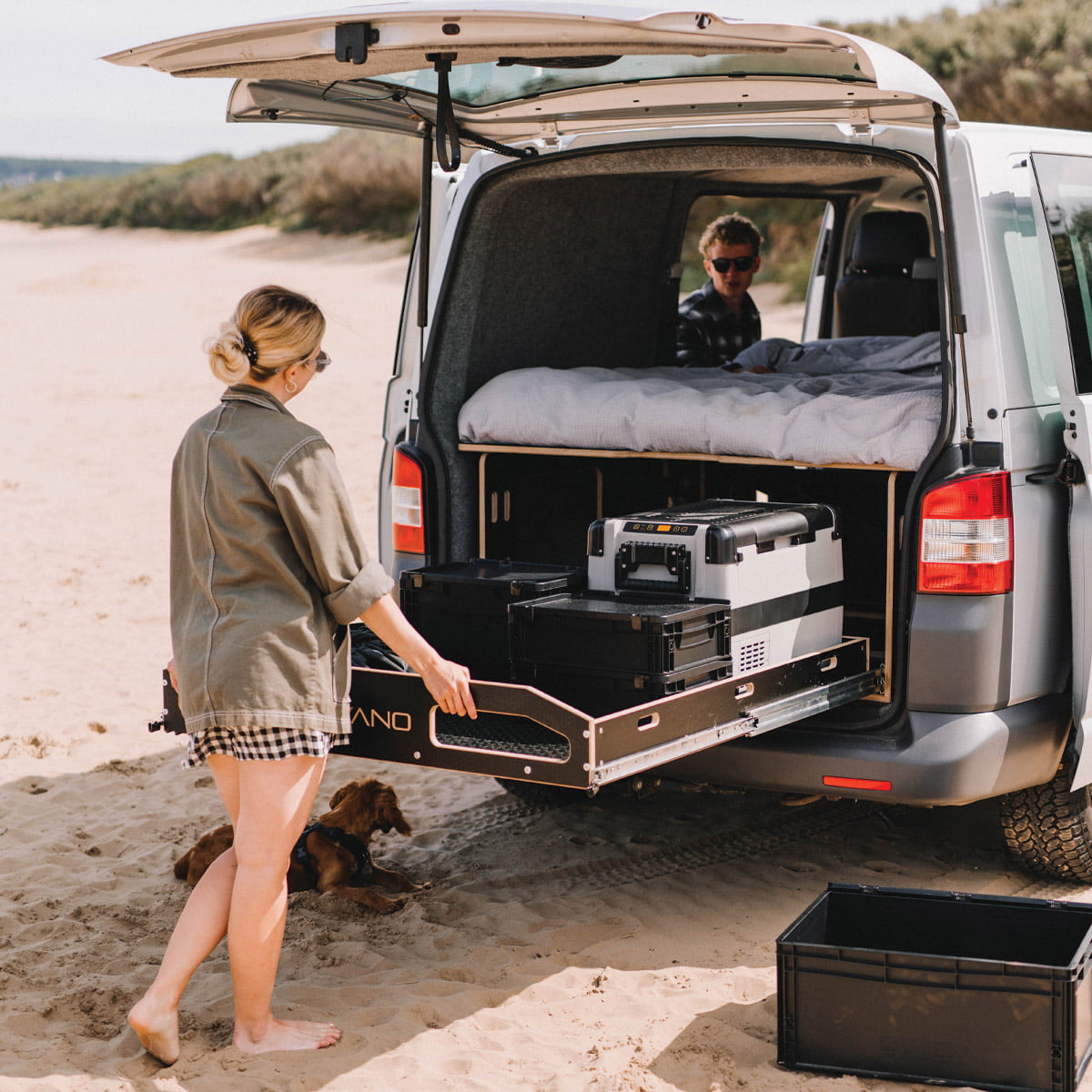


(especially if you actually need your van to be a van)
Most people don’t buy a camper van because they need storage.
They buy one because they want the lifestyle.
Freedom, spontaneity, weekends away, and the idea that the van will make life easier and more enjoyable. For a short period of time usually early on — that often feels true.
Where things start to unravel isn’t on the campsite.
It’s everywhere else.
The part that gets overlooked at the start
Almost everyone focuses on the days they imagine using the van as a camper.
A week away. A few long weekends. Maybe one or two proper trips a year.
What tends to be forgotten is that for most owners, the van is not being used as a camper for the other 355 days. It’s either being used as a normal vehicle — or it’s sitting on the drive because it no longer works well as one.
That’s where the gap between expectation and reality opens up.
When the lifestyle promise breaks
We see this most clearly with customers who come to us after owning a converted van.
They don’t usually say the conversion was badly made. In many cases, it wasn’t. What they admit, often with hindsight, is that they rushed into the idea.
Before alternatives like ours existed, there weren’t many options. If you approached a conversion specialist, you were almost always guided toward a fairly standard layout: fixed bed, cupboards down one side, internal kitchen, rock-and-roll seating.
It’s sold around the idea of camping.
What rarely gets discussed is how that same layout performs for everything else.
The reality of mixed-use vans
As soon as a van has to do more than one job, traditional conversions start to struggle.
For work
Tools and equipment don’t sit comfortably in a fully converted van. If they can be squeezed in at all, there’s a constant worry about damaging expensive interiors. Loads move. Space becomes awkward. Practicality drops off quickly.
For day-to-day life
Rock-and-roll beds often push seating far back into the van. Kids end up miles away from the driver. Storage for everyday things like shopping, bags, or prams is limited to small cupboards that look neat but hold very little.
On top of that, the van is carrying a lot of permanent weight — fridges, water systems, cooking equipment — whether they’re used or not. Fuel economy suffers, the vehicle feels heavier, and it stops being the obvious choice for everyday use.
The end result is often that the van either:
-
Sits unused for long periods, or
-
Forces the owner to adapt their life around it
Neither obviously being the original intention.
Even for camping, compromises show up
Ironically, even when used as a camper, many standard layouts fall short.
Reduced-width beds are one of the most common complaints. Cupboards that looked generous on paper struggle to hold real gear. Internal cooking often goes unused because most people would rather cook outside, especially in a van where sleeping and living space are already tight.
Over time, people start to realise they’re not actually using most of what they paid for.
That’s usually the turning point.
Who traditional conversions do work for?
To be clear, full conversions aren’t wrong — they’re just very specific.
They tend to work best for people who:
-
Have a lot of time to spend in the van
-
Use it almost exclusively as a camper
-
Don’t need it to double as a work or family vehicle
A retired couple is often cited as the example. Even then, it’s not guaranteed. In many cases, if someone is genuinely spending long periods inside a van — particularly in the UK, where the weather often forces you indoors — a larger vehicle would arguably be the better choice anyway.
As soon as the van becomes mixed-use, compromises creep in fast.
The business reality that quietly decides everything
There’s also a practical constraint that affects a large proportion of owners.
A significant number of our customers are self-employed or business owners. In many of those cases, the decision to buy a van is made for business reasons first. The van already exists — or is going to exist — regardless.
The question isn’t whether to buy a van.
It’s what to do with it.
For most people in this position, the assumptions are:
-
A campers not tax deductible
-
A camper wouldn’t work for work anyway
-
So leisure use just isn’t really an option
That’s why it’s actually very rare for someone running a business to convert a working van into a full camper. Not because they don’t want to — but because it breaks too many practical rules at once.
What most people don’t realise is that there is a middle ground.
The moment people join the dots
There’s a sentence we hear regularly, usually said while standing next to one of our units:
“We realised we didn’t need or use most of the stuff we had in our old van — we just needed a bed for camping. This is actually what we needed all along.”
That realisation almost always comes after owning a converted van, not before.
People look back and see that the lifestyle they were sold only really existed for a couple of weeks a year. For the rest of the time, the van was heavier, less practical, and harder to live with than it needed to be.
For business owners especially, they also realise they’d been leaving opportunity on the table — using the van purely as a van, when it could have been doing far more without compromising its role.

A different way of thinking about campervans
The alternative isn’t about stripping everything back or giving something up.
It’s about starting from reality rather than aspiration.
For most people, a van needs to:
-
Work day to day
-
Carry tools, equipment, or family
-
Switch roles quickly
-
And still allow them to go away comfortably when the chance arises
That’s the problem space our systems were designed around. Not to replace campervans — but to give people an option that fits the way they actually live and work.
Final thought
Most people don’t regret buying a van.
What they regret is committing too early to a layout that only worked for a small part of their life.
Once you’re honest about how often the van will actually be used as a camper — and what else it needs to do — the right approach usually becomes much clearer.